Andrew Carnegie
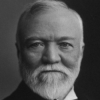
Andrew Carnegie
Andrew Carnegiewas a Scottish-American industrialist who led the enormous expansion of the American steel industry in the late 19th century. He is often identified as one of the richest people in history, alongside John D. Rockefeller and Jakob Fugger. He built a leadership role as a philanthropist for the United States and the British Empire. During the last 18 years of his life, he gave away to charities, foundations, and universities about $350 million– almost 90 percent of his fortune...
NationalityScottish
ProfessionEntrepreneur
Date of Birth25 November 1835
CityDunfermline, Scotland
I don't believe in God. My God is patriotism. Teach a man to be a good citizen and you have solved the problem of life.
I believe the true road to preeminent success in any line is to make yourself master in that line. I have no faith in the policy of scattering one's resources, and in my experience I have rarely if ever met a man who achieved preeminence in money making.. certainly never one in manufacturing.. who was interested in many concerns.
I believe that the road to pre-eminent success in any line of work is to make yourself master of that line of work.
You are what you think. So just think big, believe big, act big, work big, give big, forgive big, laugh big, love big and live big.
I believe that the true road to preeminent success in any line is to make yourself master of that line
There is very little success where there is very little laughter.
While the law [of competition] may be sometimes hard for the individual, it is best for the race, because it insures the survival of the fittest in every department. We accept and welcome, therefore, as conditions to which we must accommodate ourselves, great inequality of environment, the concentration of business, industrial and commercial, in the hands of a few, and the law of competition between these, as being not only beneficial, but essential for the future progress of the race.
A word, a look, an accent, may affect the destiny not only of individuals, but of nations. He is a bold man who calls anything a trifle.
Why should men leave great fortunes to their children? If this is done from affection, is it not misguided affection? Observation teaches that, generally speaking, it is not well for the children that they should be so burdened.
A man who was generous with his wealth. It has been reported that during his lifetime, Carnegie gave away over $350 million of his money to help others.
The man who dies leaving behind him millions of available wealth, which was his to administer during his life, will pass away unwept, unhonoured and insung no matter to what uses he leaves the dross which he cannot take with him.
The worlds civilization started from the day on which everyone received reward for labour.
Touch his head, and he will bargain and argue with you to the last; Touch his heart, and he falls upon your breast.
If thou dost not sow, thou shalt not reap,