Aleksandr Solzhenitsyn
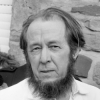
Aleksandr Solzhenitsyn
Aleksandr Isayevich Solzhenitsyn was a Russian novelist, historian, and short story writer. He was an outspoken critic of the Soviet Union and its totalitarianism and helped to raise global awareness of its Gulag forced labor camp system. He was allowed to publish only one work in the Soviet Union, One Day in the Life of Ivan Denisovich, in the periodical Novy Mir. After this he had to publish in the West, most notably Cancer Ward, August 1914, and The Gulag...
NationalityRussian
ProfessionNovelist
Date of Birth11 December 1918
CityKislovodsk, Russia
CountryRussian Federation
The next war... may well bury Western civilization forever.
Justice is conscience, not a personal conscience but the conscience of the whole of humanity. Those who clearly recognize the voice of their own conscience usually recognize also the voice of justice.
Any man who has once proclaimed violence as his method is inevitably forced to take the lie as his principle.
A state of war only serves as an excuse for domestic tyranny.
Anyone who has proclaimed violence his method inexorably must choose lying as his principle.
If only it were all so simple! If only there were evil people somewhere insidiously committing evil deeds, and it were necessary only to separate them from the rest of us and destroy them. But the line dividing good and evil cuts through the heart of every human being. And who is willing to destroy a piece of his own heart?
Violence can only be concealed by a lie, and the lie can only be maintained by violence.
I have not painted the dark reality in rose-tinted shades but I do include a clear way, a search for something brighter, some way out - most importantly in the spiritual sense.
The demands of internal growth are incomparably more important to us... than the need for any external expansion of our power.
When I was young, the early death of my father cast a shadow over me - and I was afraid to die before all my literary plans came true. But between 30 and 40 years of age my attitude to death became quite calm and balanced. I feel it is a natural, but no means the final, milestone of one's existence.
Communist propaganda would sometimes include statements such as "we include almost all the commandments of the Gospel in our ideology". The difference is that the Gospel asks all this to be achieved through love, through self-limitation, but socialism only uses coercion. This is one point.
For me faith is the foundation and support of one's life.
Religion itself cannot but be dynamic. In order to combat modern materialistic mores, to fight nihilism and egotism, religion must also develop, must be flexible in its forms, and it must have a correlation with the cultural forms of the epoch.
The term "national idea" is an unclear one. One might think of it as a widely shared understanding among a people as to the desired way of life in their country, an idea that holds sway over the population. A unifying concept like that can be useful, but should never be created artificially or imposed top-down by the powers-that-be.