Aleksandr Solzhenitsyn
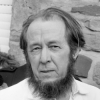
Aleksandr Solzhenitsyn
Aleksandr Isayevich Solzhenitsyn was a Russian novelist, historian, and short story writer. He was an outspoken critic of the Soviet Union and its totalitarianism and helped to raise global awareness of its Gulag forced labor camp system. He was allowed to publish only one work in the Soviet Union, One Day in the Life of Ivan Denisovich, in the periodical Novy Mir. After this he had to publish in the West, most notably Cancer Ward, August 1914, and The Gulag...
NationalityRussian
ProfessionNovelist
Date of Birth11 December 1918
CityKislovodsk, Russia
CountryRussian Federation
You only have power over people so long as you don't take everything away from them. But when you've robbed a man of everything, he's no longer in your power - he's free again.
I have spent all my life under a Communist regime, and I will tell you that a society without any objective legal scale is a terrible one indeed. But a society with no other scale but the legal one is not quite worthy of man either.
I am of course confident that I will fulfill my tasks as a writer in all circumstances -- from my grave even more successfully and more irrefutably than in my lifetime.
The essence of life will never be captured by even the greatest of formulas.
If so far we have been unable to see clearly or to reflect the eternal lineaments of truth, is it not because we too are still moving towards some end-because we are still alive?
Each person has his special moment of life when he unfolded himself to the fullest, felt to the deepest, and expressed himself to the utmost, to himself and to others.
A hard life improves the vision.
You can resolve to live your life with integrity. Let your credo be this: Let the lie come into the world, let it even triumph. But not through me.
I have not painted the dark reality in rose-tinted shades but I do include a clear way, a search for something brighter, some way out - most importantly in the spiritual sense.
The demands of internal growth are incomparably more important to us... than the need for any external expansion of our power.
When I was young, the early death of my father cast a shadow over me - and I was afraid to die before all my literary plans came true. But between 30 and 40 years of age my attitude to death became quite calm and balanced. I feel it is a natural, but no means the final, milestone of one's existence.
Communist propaganda would sometimes include statements such as "we include almost all the commandments of the Gospel in our ideology". The difference is that the Gospel asks all this to be achieved through love, through self-limitation, but socialism only uses coercion. This is one point.
For me faith is the foundation and support of one's life.
Religion itself cannot but be dynamic. In order to combat modern materialistic mores, to fight nihilism and egotism, religion must also develop, must be flexible in its forms, and it must have a correlation with the cultural forms of the epoch.