Albert Einstein
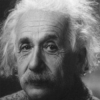
Albert Einstein
Albert Einstein; 14 March 1879 – 18 April 1955) was a German-born theoretical physicist. He developed the general theory of relativity, one of the two pillars of modern physics.:274 Einstein's work is also known for its influence on the philosophy of science. Einstein is best known in popular culture for his mass–energy equivalence formula E = mc2. He received the 1921 Nobel Prize in Physics for his "services to theoretical physics", in particular his discovery of the law of the photoelectric...
NationalityGerman
ProfessionScientist
Date of Birth14 March 1879
CityUlm, Germany
CountryGermany
We can invent as many theories we like, and any one of them can be made to fit the facts. But that theory is always preferred which makes the fewest number of assumptions.
I have little patience with scientists who take a board of wood, look for its thinnest part, and drill a great number of holes where drilling is easy.
The importance of a problem should not be judged by the number of pages devoted to it.
Academic chairs are many, but wise and noble teachers are few; lecture-rooms are numerous and large, but the number of young people who genuinely thirst after truth and justice is small
I have lived to prove Thoreau's contention that a man is rich in proportion to the number of things which he can afford to let alone.
The grand aim of all science is to cover the greatest number of empirical facts by logical deduction from the smallest number of hypotheses or axioms.
The number of natural hypothesis that can explain any given phenomena is infinite.
As soon as science has emerged from its initial stages, theoretical advances are no longer achieved merely by a process of arrangement. Guided by empirical data, the investigator rather develops a system of thought which, in general, is built up logically from a small number of fundamental assumptions, the so-called axioms. We call such a system of thought a theory. The theory finds the justification for its existence in the fact that it correlates a large number of single observations, and it is just here that the 'truth' of the theory lies.
Small is the number of them that see with their own eyes, and feel with their own hearts
Why does this applied science, which saves work and makes life easier, bring us so little happiness? The simple answer runs: Because we have not yet learned to make sensible use of it.
Try not to become a man of success but rather to become a man of value.
To the extent math refers to reality, we are not certain; to the extent we are certain, math does not refer to reality.
We found there were people doing acupuncture, meditation, naturopathy and other forms of alternative or complementary medicine ... but it was being done in a disorganized way,
We cannot despair of humanity, since we are ourselves human beings