Albert Einstein
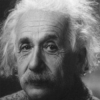
Albert Einstein
Albert Einstein; 14 March 1879 – 18 April 1955) was a German-born theoretical physicist. He developed the general theory of relativity, one of the two pillars of modern physics.:274 Einstein's work is also known for its influence on the philosophy of science. Einstein is best known in popular culture for his mass–energy equivalence formula E = mc2. He received the 1921 Nobel Prize in Physics for his "services to theoretical physics", in particular his discovery of the law of the photoelectric...
NationalityGerman
ProfessionScientist
Date of Birth14 March 1879
CityUlm, Germany
CountryGermany
Be a loner. That gives you time to wonder...
Turkish soldiers are very brave. They love their homeland and they do not hesitate to give their lives for it if necessary.
Dostoevsky gives me more than any scientist, more than Gauss.
Work is the only thing that gives substance to life.
The value of a man resides in what he gives
Don't dream of being a good person, be a human being is valuable and gives value to life.
If I give you a pfennig, you will be one pfennig richer and I'll be one pfennig poorer. But if I give you an idea, you will have a new idea, but I shall still have it too.
My internal and external life depend so much on the work of others that I must make an extreme effort to give as much as I receive.
Only morality in our actions can give beauty and dignity to life.
Mankind must give up war in the Atomic Era. What is at stake is the life or death of humanity.
The most beautiful gift of nature is that it gives one pleasure to look around and try to comprehend what we see.
Imagination is everything. It is the preview of life's coming attractions. Imagination is more important than knowledge. Never give up on what you really want to do. The person with big dreams is more powerful than one with all the facts.
Be a loner. That gives you time to wonder, to search for the truth. Have holy curiosity. Make your life worth living.
It must be conceded that a theory has an important advantage if its basic concepts and fundamental hypotheses are 'close to experience,' and greater confidence in such a theory is certainly justified. There is less danger of going completely astray, particularly since it takes so much less time and effort to disprove such theories by experience. Yet more and more, as the depth of our knowledge increases, we must give up this advantage in our quest for logical simplicity in the foundations of physical theory...