Albert Einstein
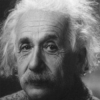
Albert Einstein
Albert Einstein; 14 March 1879 – 18 April 1955) was a German-born theoretical physicist. He developed the general theory of relativity, one of the two pillars of modern physics.:274 Einstein's work is also known for its influence on the philosophy of science. Einstein is best known in popular culture for his mass–energy equivalence formula E = mc2. He received the 1921 Nobel Prize in Physics for his "services to theoretical physics", in particular his discovery of the law of the photoelectric...
NationalityGerman
ProfessionScientist
Date of Birth14 March 1879
CityUlm, Germany
CountryGermany
(Reply on what constitutes scientific proof:)"The question is much too difficult for me.
To be sure, the doctrine of a personal God interfering with natural events could never be refuted, in the real sense, by science, for this doctrine can always take refuge in those domains in which scientific knowledge has not yet been able to set foot. But I am persuaded that such behavior on the part of the representatives of religion would not only be unworthy but also fatal. For a doctrine which is able to maintain itself not in clear light, but only in the dark, will of necessity lose its effect on mankind, with incalculable harm to human progress.
The years of searching in the dark for a truth that one feels but cannot express, the intense desire and the alternations of confidence and misgiving until one breaks through to clarity and understanding, are known only to him who has experienced them himself.
As the area of light expands, so does the perimeter of darkness.
The truth isn't always a blinding light. Sometimes it's a deep and dazzling darkness, that illuminates - and burns - just as surely.
Once again you are wrong sir, darkness does not exist either. Darkness is in reality the absence of light. Light we can study, but not darkness. In fact we can use Newton's prism to break white light into many colors and study the various wavelengths of each color. You cannot measure darkness. A simple ray of light can break into a world of darkness and illuminate it. How can you know how dark a certain space is? You measure the amount of light present. Isn't this correct? Darkness is a term used by man to describe what happens when there is no light present.
The years of anxious searching in the dark, with their intense longing, their alternations of confidence and exhaustion and the final emergence into the light -- only those who have experienced it can understand it.
I should very much like to remain in the darkness of not having been analyzed.
The normal objective of my thought affords no insight into the dark places of human will and feeling.
Why does this applied science, which saves work and makes life easier, bring us so little happiness? The simple answer runs: Because we have not yet learned to make sensible use of it.
Try not to become a man of success but rather to become a man of value.
To the extent math refers to reality, we are not certain; to the extent we are certain, math does not refer to reality.
We found there were people doing acupuncture, meditation, naturopathy and other forms of alternative or complementary medicine ... but it was being done in a disorganized way,
We cannot despair of humanity, since we are ourselves human beings